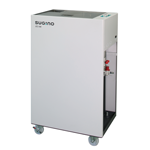
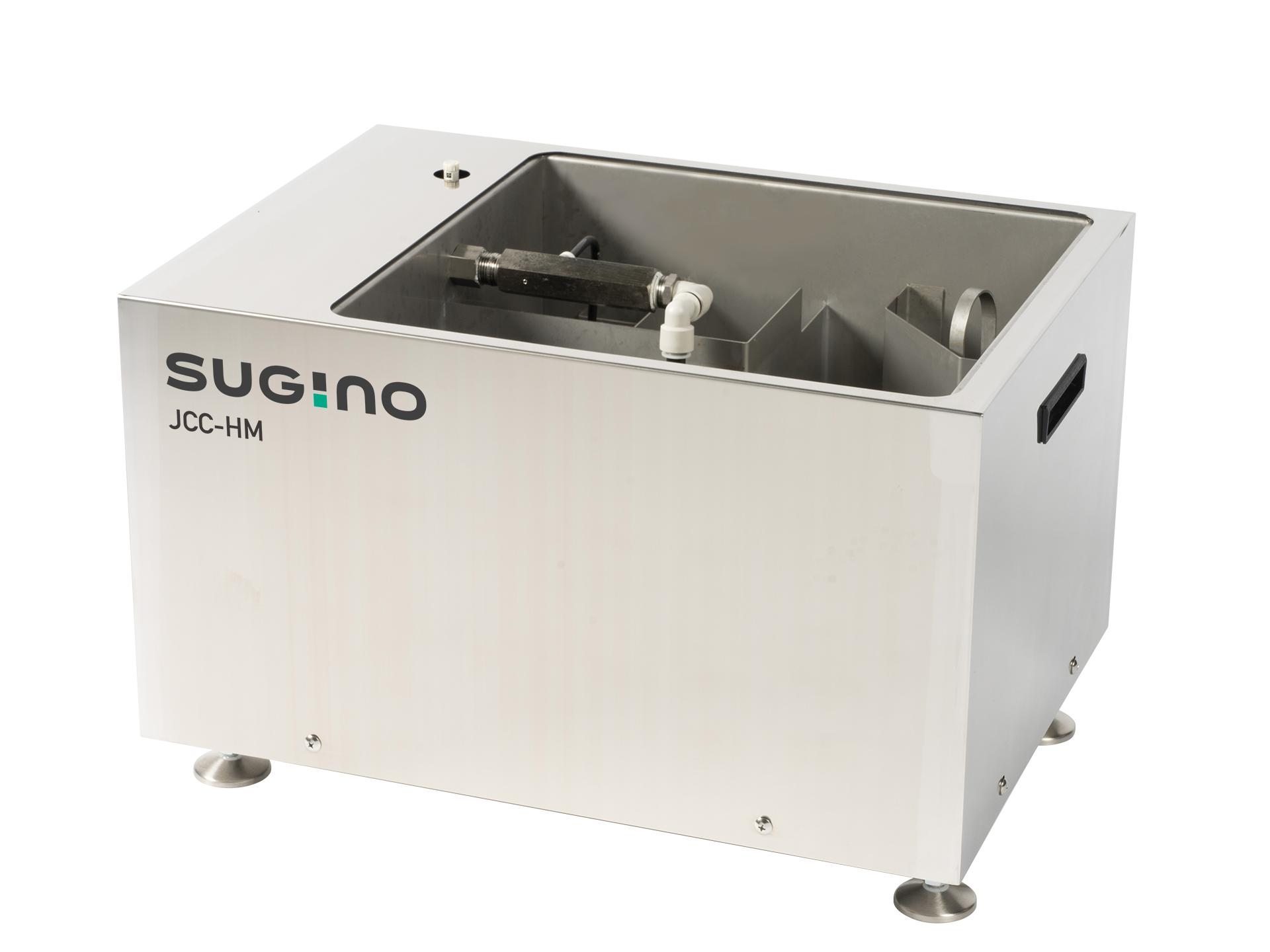
Sugino JCC-HM Portable Coolant Cleaner and Tramp Oil Remover
The portable, easy way to clean fine contamination and oil from your coolant and liquids.
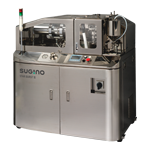
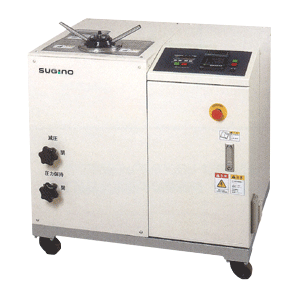
The Sugino JCC-HM is a portable, air-powered coolant purification unit that removes tramp oil, debris, metal fines and sludge from machine-tool sumps and parts-washer tanks. It uses microbubbles 1–100 µm in diameter to float contaminants out of water-miscible coolant and aqueous cleaning fluid. It runs on shop air alone, with no electricity and no filters to replace. It can be moved from machine to machine, for excellent useability.
Processes
13 L/min (3.4 GPM)
Shop air only, about
1.4 SCFM at 22 psi
No filters or other consumables
35 kg (77 lb)
on casters; moves machine to machine
What the JCC-HM Removes from Coolant

Tramp Oil: Way lube, hydraulic oil and spindle oil, both floating on the surface and dispersed in the liquid. Most skimmers only reach the surface layer.

Metal Fines and Sludge: Fine particles that pass through chip conveyors and settle as sludge in the tank.

Oil Residue and Fine Solids: From parts washers, grinders and press-mold cleaning.

Odor-Causing Conditions: Aerating the fluid helps suppress the anaerobic bacteria that cause the "Monday morning" coolant smell.
The result: coolant lasts longer between changes, parts come out cleaner, and pumps and seals see less wear.
How microbubble coolant cleaning works
- Connect shop air and two hoses: one pulling dirty fluid from the sump (IN), one returning clean fluid (OUT).
- The unit generates microbubbles inside its 25 L treatment tank.
- Oil droplets and fine particles attach to the bubbles and rise to the surface.
- A weir-and-baffle system and coalescer trap the floated contaminants so they can't remix into the fluid.
- Clean fluid flows back to the sump. Contaminants collect for disposal, and the tank parts lift out for cleaning.
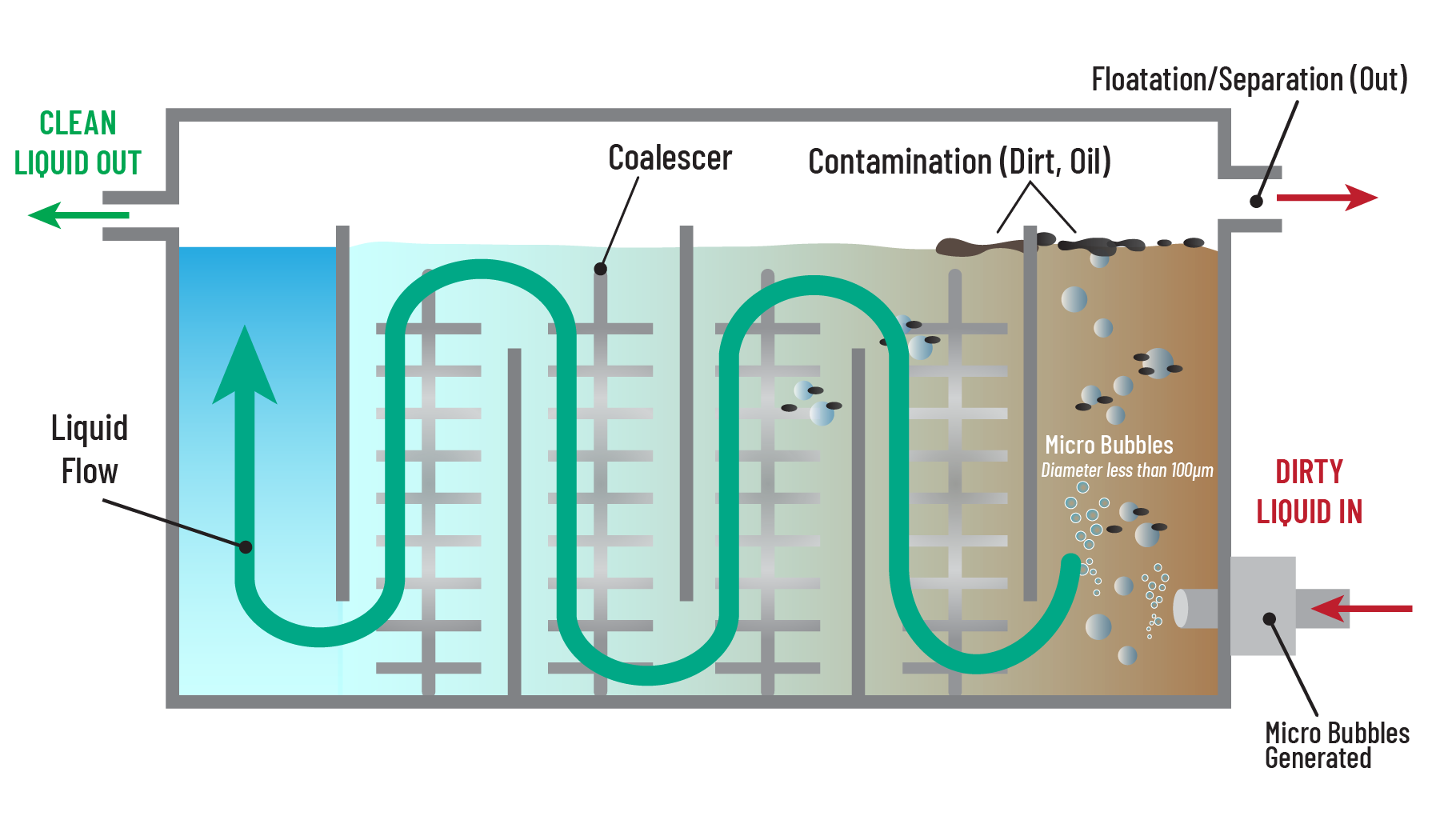
A look inside:
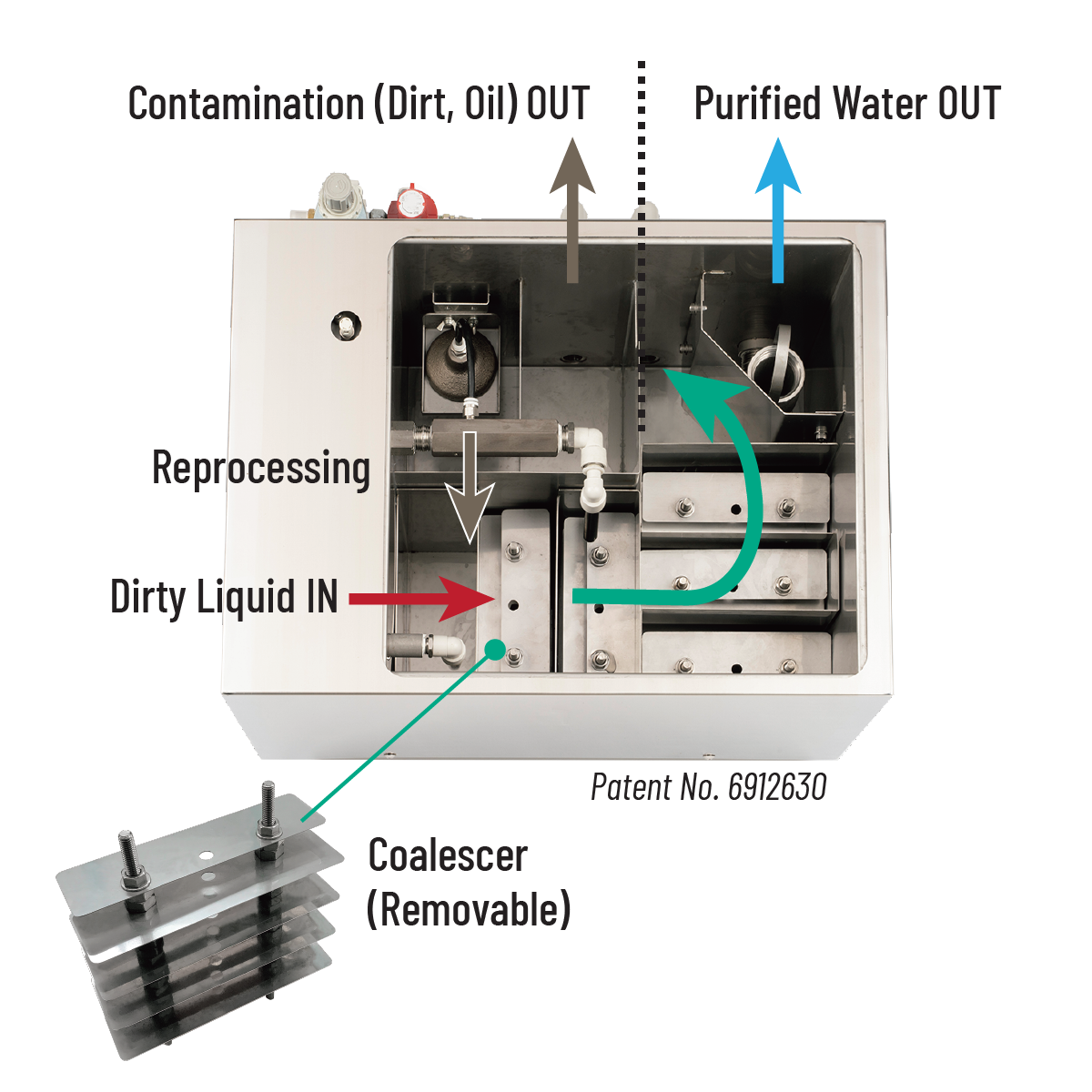
Which fluids and machines it works with
The JCC-HM2 is built for water-based fluids. It is not for straight (neat) cutting oils.
Typical equipment:
CNC machining centers, lathes, grinders, high-pressure parts washers and press molds. Maximum fluid temperature is 50 °C (122 °F).
| Fluid type | Suitable? |
|---|---|
| Synthetic coolant | Yes |
| Semi-synthetic coolant | Yes |
| Soluble-oil (emulsion) coolant | Yes, with conditions |
| Aqueous parts-washer solution | Yes |
| Grinding coolant | Yes |
| Straight / neat cutting oil | No |
Increases water/coolant life and helps to protect important machine components such as pumps and seals
Aerates the fluid bath to help prevent bacterial growth and reduce foul odors
Helps to eliminate residue on finished parts and reduce the cost of fluid chemistry disposal and replacement
NOTE: Water soluble mixtures and emulsions may separate
Air is the Only Power Source Needed
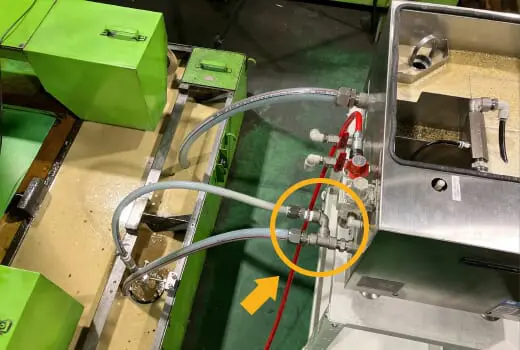
Installation is simple and operation can start immediately. Preparation is complete after connecting just two hoses (IN/OUT) and air.
Get More Information or Expert Help

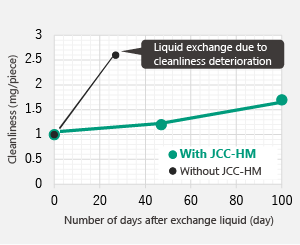
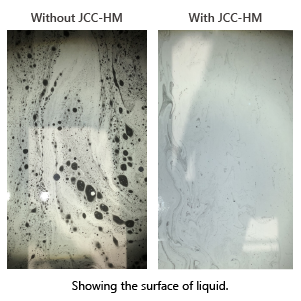
Specifications
Air Consumption
Noise
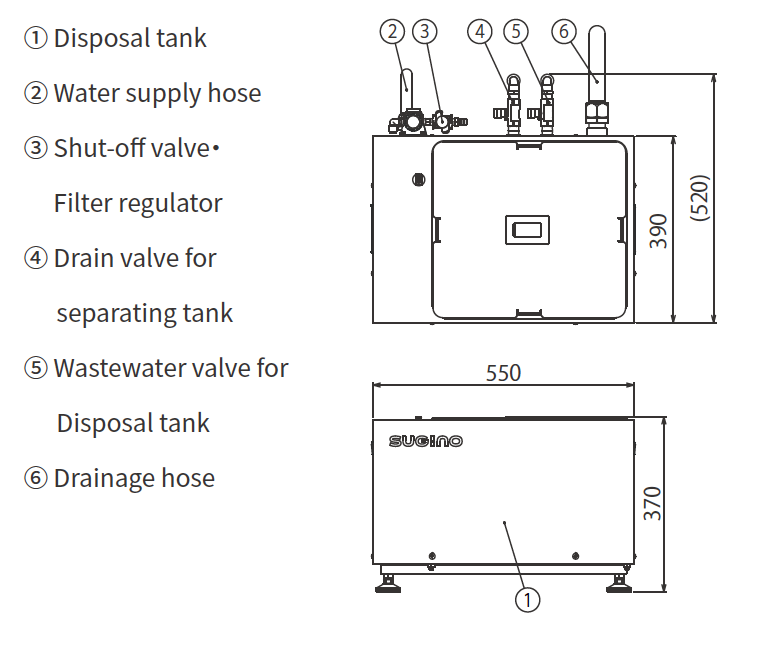
Dimensional Drawing (mm)
JCC-HM Exclusive Optional Floating Oil Recovery Unit
Remove both floating oil and oil in the liquid, for better performance.
The optional floating oil recovery unit allows you to add even more functionality - simply connect it to the water supply of JCC-HM. If you are already using the HM, it can be retrofitted to recover oil from both the top of the liquid level, and within the liquid itself.
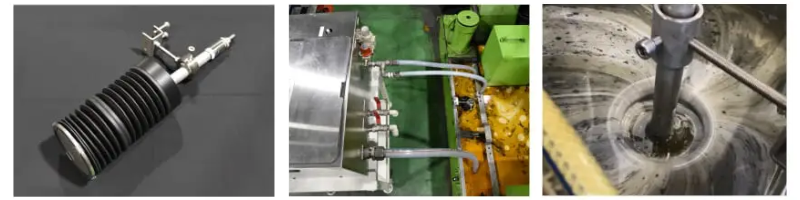
FEATURES
Recovering both the oil at the surface level and within the liquid, the JCC-HM doubles its processing speed to remove contaminants from your fluid tank.
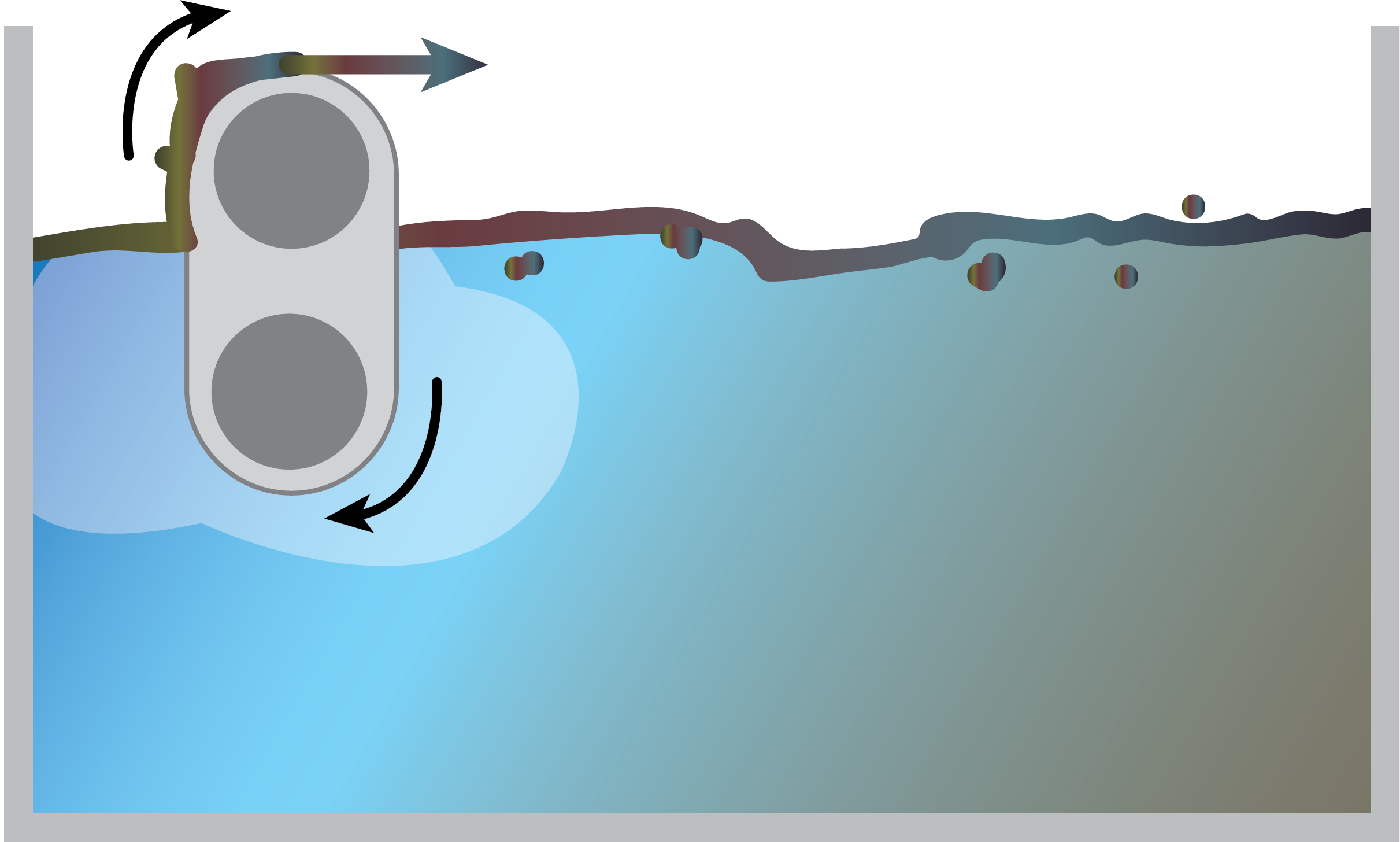
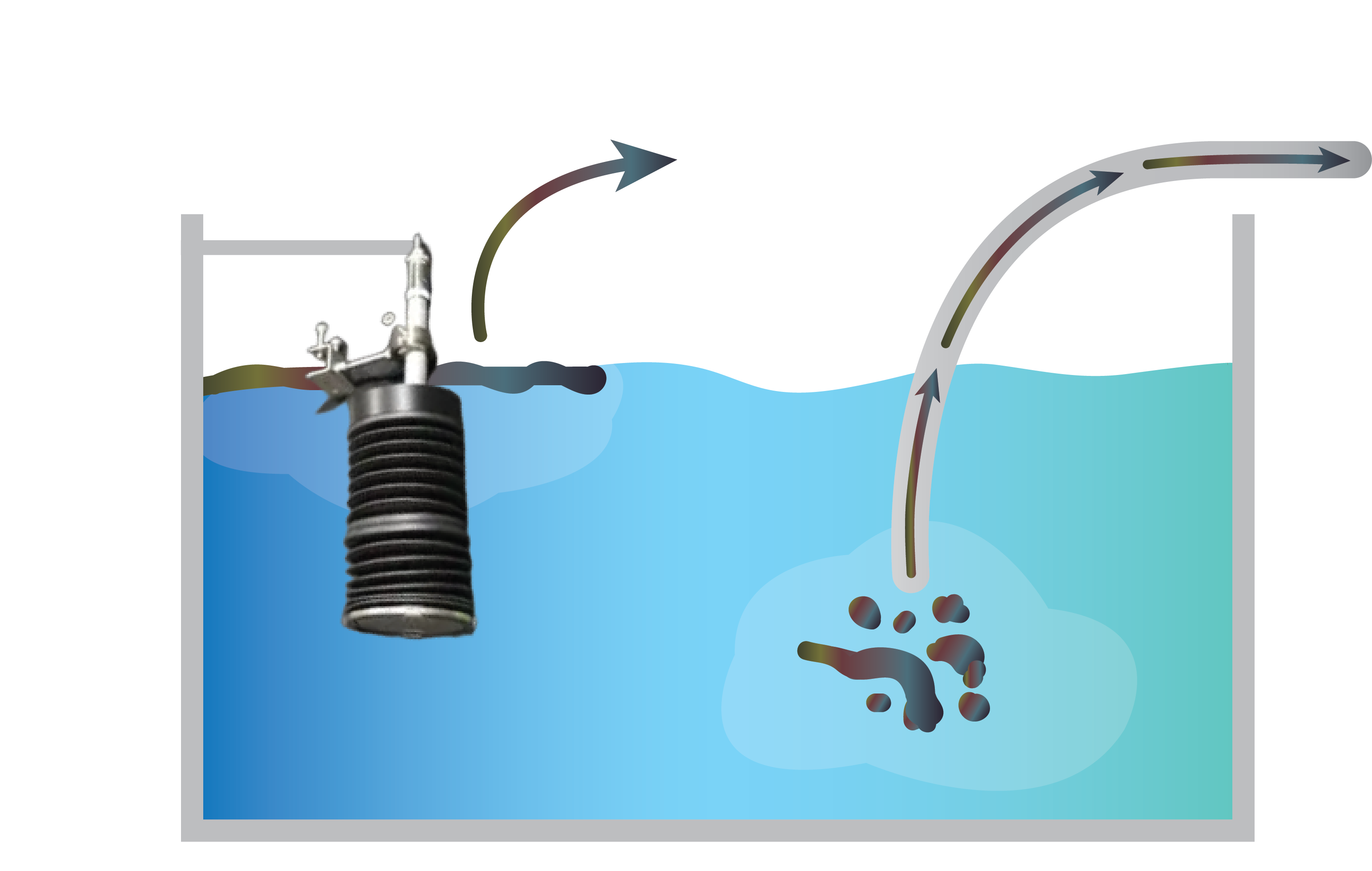
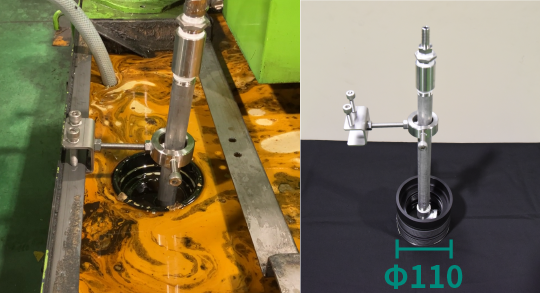
Fixes to the tank for stable operation.
In order to stably recover the oil in the liquid level, we adopted a method of fixing it to the tank. In the float type, it is affected by the fluctuation of the height of the liquid level, but by fixing it to the tank and installing it, it will continue to recover the floating oil stably.
In addition, the outer diameter of the unit is reduced to φ110, so it can be installed smoothly even in a tank with a small opening.
The bellows automatically follows the fluctuating level of the liquid.
The bellows portion of the unit can stretch up to a max. of 100 mm, maintaining an optimal position for stable recovery of floating oil at the surface of the liquid.
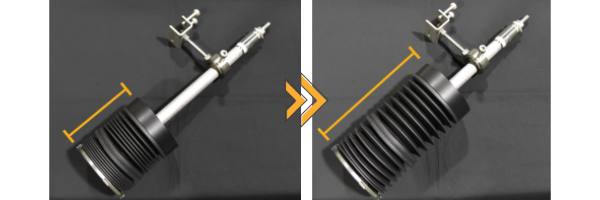
Designed to be retrofit to your existing JCC-HM, or added when the situation requires it.
The optional float unit can be attached to an existing JCC-HM processing circuit whenever you need it. Having it on-hand gives you the option to add it later according to the condition of the tank you want to process.
Case Study One - Grinder
Removes 97% of sludge in the liquid, preventing workpiece damage and poor quality.
Case Study Two - Brass Processing Equipment (Lathes)
Case Study Three - Reduction of Offensive Odors in Cutting Oil
Case Study Four - Oil Removal
Prevented spoilage and offensive odors in liquid - and
improved tool life and workpiece cleanliness.
Case Study Eight - Thoroughly Removing Oil in a Press Mold